
The Biggest Shift: From “Search Engine” to “Answer Engine”
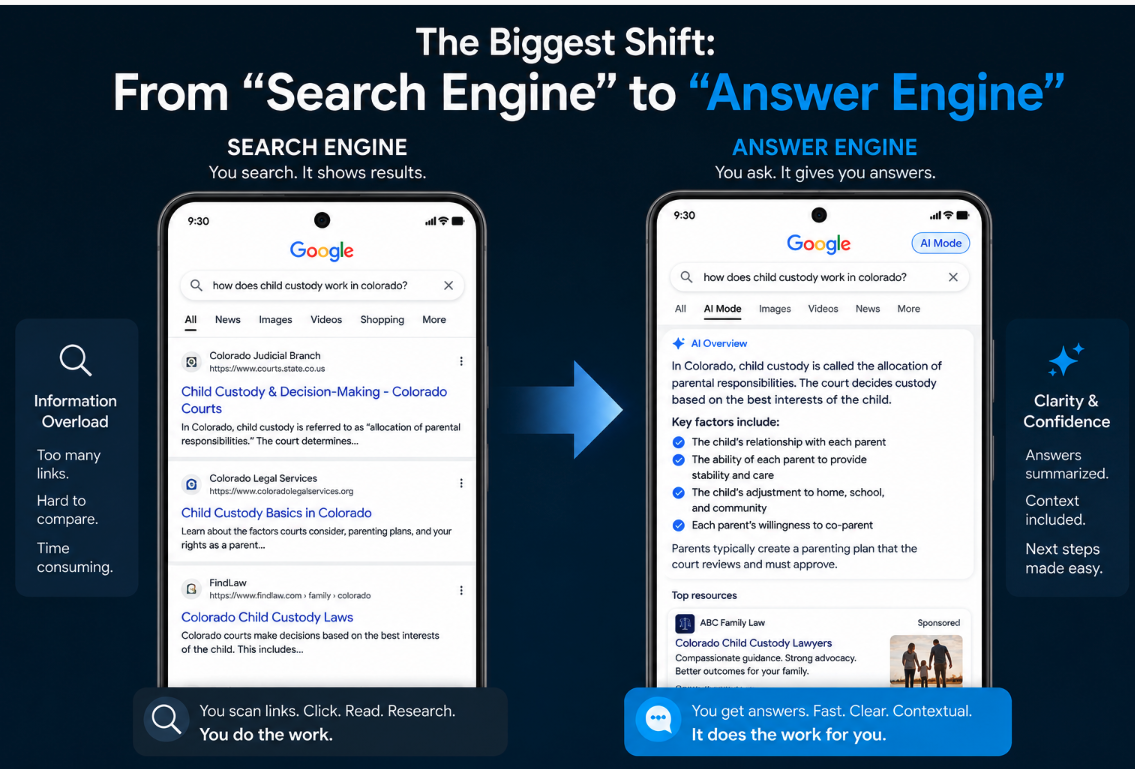
Google introduced major upgrades to AI Mode and AI Overviews, powered by Gemini AI.
The search experience is becoming more conversational and personal – allowing users to ask more complex questions instead of short keyword searches, and not always needing to do multiple searches to resolve nuanced topics.
Instead of typing:
“child custody lawyer NJ”
users may now ask:
“What should a father do if he believes the mother is violating a custody agreement in New Jersey?”
Google uses a query fan-out process to break that query into subtopics, search them all at the same time, and combine the findings into a clear response.
Google’s AI features are increasingly going to generate structured summaries at the top of the results page – often using headers or bullet points, including:
direct answers,
summaries,
recommendations,
follow-up prompts,
and contextual suggestions
before users even click a website.
For law firms this means content strategy has to evolve beyond just simple keyword targeting.
AI Mode can also preserve context for follow-up questions within the same session.
What Law Firms Need to Do
Law firms need to start producing content that answers real-world questions from potential clients searching for legal services in natural language.
This includes:
creating FAQ-style legal content
writing conversational blog articles
detailed practice area pages
structured Q&A sections
video explainers
attorney thought leadership content
Long-form blog articles can improve organic traffic and help attract new clients.
Effective legal marketing is a combination of SEO with other techniques such as website optimisation, social media and networking.
Google’s AI systems are prioritising content that demonstrates
expertise,
authority,
trustworthiness,
and clarity.
Legal topics fall under Google’s “Your Money or Your Life” (YMYL) framework – meaning trust and credibility matter even more in AI-generated search experiences, and keyword research should focus on the relevant terms people actually use.
AI Overviews Will Reduce Organic Clicks
One of the biggest concerns for publishers and marketers is the rise of AI Overviews.
Google is increasingly answering questions directly inside search results, and AI Overviews provide concise snapshots that summarise topics before users click through – reducing the need for users to visit websites to discover basic answers.
For law firms, this creates both a challenge and an opportunity. These responses can also include direct source links within the answer – giving users immediate access to supporting content.
If your firm is included in these features, it can increase visibility with potential searchers.
The Challenge
Informational legal searches may generate fewer website visits because users can get summarised legal guidance directly from Google.
Examples:
“How long does divorce take in NJ?”
“What is a restraining order?”
“Can I refuse a breathalyzer?”
“What happens after a DUI arrest?”
The Opportunity
Law firms that become trusted citation sources inside AI-generated answers will gain enormous visibility and authority.
This means law firms now need to optimize content not just for rankings – but for AI citation inclusion.
Google’s New AI Ad Formats Could Reshape Legal Marketing and Lead Generation
One of the biggest announcements from Google’s keynote was the unveiling of entirely new AI-powered ad experiences designed specifically for conversational search behavior. For law firms, these formats could help attract new clients by matching ad messages more closely to real search intent. They may also help generate leads when campaigns connect useful offers with the right audience at the right moment.
Google is no longer thinking about ads as static text placements triggered by exact-match keywords. PPC still requires a clear plan around relevant keywords and geographic targeting for legal services.
Instead, ads are becoming:
contextual,
conversational,
dynamically generated,
and AI-assisted.
The screenshots Google shared during the keynote provide a glimpse into what the future of search advertising may look like. Firms will still need to track performance and adjust campaign spend over time to protect ROI.
1. Conversational Discovery Ads
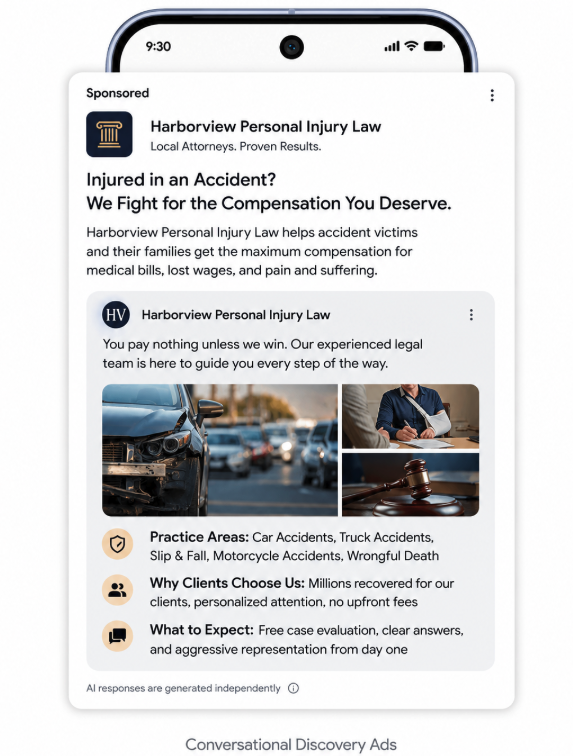
Google introduced a new format called Conversational Discovery Ads, where ads are dynamically generated based on a user’s natural-language question.
In the example Google shared, a user searches:
“Low-maintenance ways to make my home smell like a spa.”
Instead of showing traditional product ads, Google’s AI generates a recommendation-style sponsored experience complete with:
product summaries,
AI-generated explanations,
images,
and contextual recommendations.
Another example showed AI-generated sponsored recommendations for smart home fragrance devices, where Gemini summarized:
product benefits,
user experience,
ideal use cases,
and key differentiators.
For law firms, imagine a future search like:
“I need help after getting arrested for DUI in New Jersey and I’m worried about losing my license.”
Google’s AI could potentially generate:
a summarized explanation,
attorney recommendations,
legal guidance,
options or ideas for next steps,
and sponsored law firm placements tailored specifically to the user’s situation.
This is a major evolution from the traditional:
keyword → text ad → landing page
model.
Law firms will likely need:
stronger topical authority,
better educational content,
richer first-party data,
and AI-friendly website structures they can develop further
to compete in this environment.
2. Highlighted Answers Ads
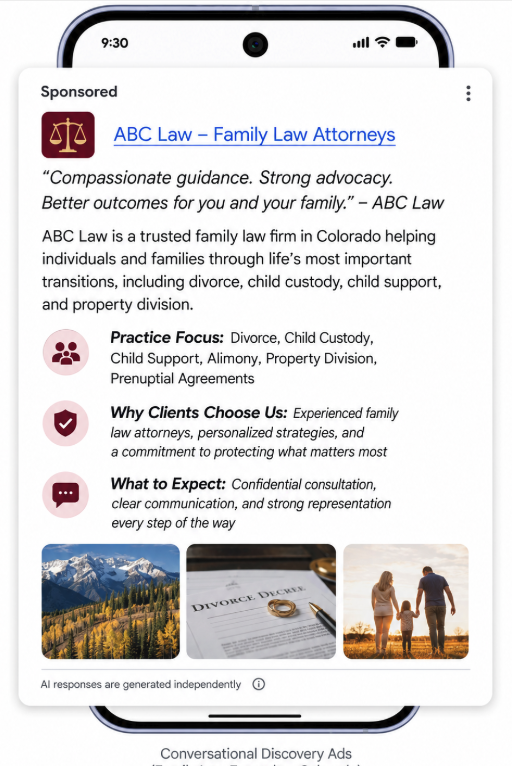
Another major format Google introduced is called Highlighted Answers.
These ads appear directly inside AI-generated recommendation lists and answer panels.
Google showcased an example where Duolingo appeared within an AI-generated recommendation experience.
The ad did not resemble a traditional PPC ad. Instead, it looked more like a trusted recommendation complete with:
summarized benefits,
bullet-point highlights,
contextual explanations,
and AI-generated supporting information.
This is extremely important for legal marketers.
Imagine someone searching:
“What’s the best way to handle a child custody dispute?”
Instead of seeing only blue links and standard search ads, Google may surface:
educational AI summaries,
attorney recommendations,
law firm comparisons,
and sponsored “Highlighted Answers.”
The law firms that provide:
authoritative educational content,
strong attorney bios that demonstrate legal skills, not just credentials,
detailed FAQs,
positive reviews,
and trustworthy brand signals
may gain a major advantage in these recommendation-driven search experiences, which may also help users explore a greater diversity of firms or sources before deciding whom to contact.
3. Business Agent for Leads Could Change Legal Intake Forever
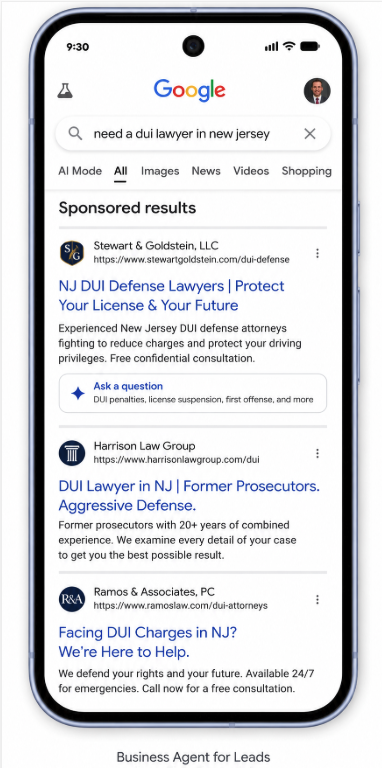
One of the more overlooked announcements was Google’s introduction of a Business Agent for Leads, one of Google’s new AI-driven solutions for lead handling.
Google described this as an AI-powered chat experience that replaces traditional lead forms with conversational interactions trained on a business’s website.
In Google’s example, users could directly interact with businesses from within the search experience itself, a type of experience that can improve engagement with clients and streamline intake operations.
Instead of filling out:
name,
phone number,
email,
and “tell us about your case,”
users may begin interacting directly with AI-powered intake assistants embedded inside Google’s ad ecosystem.
For law firms, this could become extremely powerful.
Imagine a prospective client asking:
“Do I need a lawyer for my first DUI?”
“How much does a divorce consultation cost?”
“Can I fight a restraining order?”
“How does child custody work in New Jersey?”
The AI assistant could:
answer preliminary questions,
qualify leads,
gather intake information,
and book consultations automatically, with chat-style support available in near-real time or 24/7.
This could dramatically improve:
lead quality,
response speed,
conversion rates,
and user experience.
However, it also means law firms will need:
highly structured websites,
strong FAQ content,
AI-readable information architecture,
and accurate intake workflows.
The Death of Pure Keyword Targeting?
Not completely — but keyword targeting is becoming less dominant.
Google’s AI systems are increasingly evaluating:
user intent,
conversational context,
behavioral signals,
personalization,
semantic meaning, which gives firms less control over exact query matching than before even as they can still shape topical relevance,
and historical interactions
instead of relying purely on exact search terms.
For law firms, this means campaigns should evolve from:
“buying keywords”
to:
“owning legal topics and intent clusters.”
That shift is strongest when firms apply sound SEO practices to build authority around the topics and intent patterns they want to win.
Why First-Party Data Matters More Than Ever
Google emphasized data integration heavily during Marketing Live.
Law firms that connect:
CRM data,
lead qualification,
signed cases,
offline conversions,
call tracking,
and intake outcomes
into Google Ads will likely gain a major advantage.
Tools such as Google Ads reporting and Google Analytics help connect campaign performance to business outcomes.
As AI automates more campaign optimization, the quality of your data and measurement tools becomes your competitive advantage.
For law firms, this means:
integrating Google Ads with CRM systems,
tracking retained cases instead of just leads,
implementing enhanced conversions,
and feeding revenue data back into ad platforms.
Firms still optimizing campaigns based solely on form submissions may fall behind, while better measurement can reveal growth in traffic, conversions, and user sessions.
Video Content Will Become More Important
Google also reinforced the importance of YouTube and multimodal search experiences.
Users can now search across voice, text, and images in one experience, along with:
voice,
images,
videos,
screenshots,
and conversational prompts.
This creates a major opportunity for lawyers to explore more discovery paths by producing:
FAQ videos,
legal explainers,
YouTube Shorts,
attorney interviews,
and educational content.
A short educational video post can also support visibility in these search experiences.
Video content may become a major trust signal inside AI-powered search ecosystems.
What Law Firms Should Do Right Now
1. Build Topic Authority
Create deep content clusters around practice areas as part of a broader marketing plan to increase visibility, attract new clients, establish authority, and differentiate your firm for growth and revenue. This approach also helps expand visibility across related searches. Focus on areas like:
divorce,
DUI,
custody,
family law,
immigration,
personal injury,
domestic violence,
and restraining orders.
Building this authority early helps your firm stay ahead of competitors.
2. Optimize for AI Answers
Write content in:
conversational language,
question-answer format,
structured sections,
concise summaries,
and natural language.
3. Improve First-Party Data
Integrate:
CRM systems,
offline conversion tracking,
call tracking,
intake outcomes,
and enhanced conversions.
4. Produce More Video Content
Educational attorney videos can help law firms appear in:
AI search,
YouTube,
multimodal search,
and recommendation-based experiences.
5. Focus on Brand Building
As AI search reduces clicks, branded trust becomes even more important.
Stronger brand building can help a law firm or company stand out when AI reduces direct website visits.
Some firms may need outside support from an agency to strengthen brand visibility in AI search.
Consumers may increasingly choose firms they already recognize and trust.