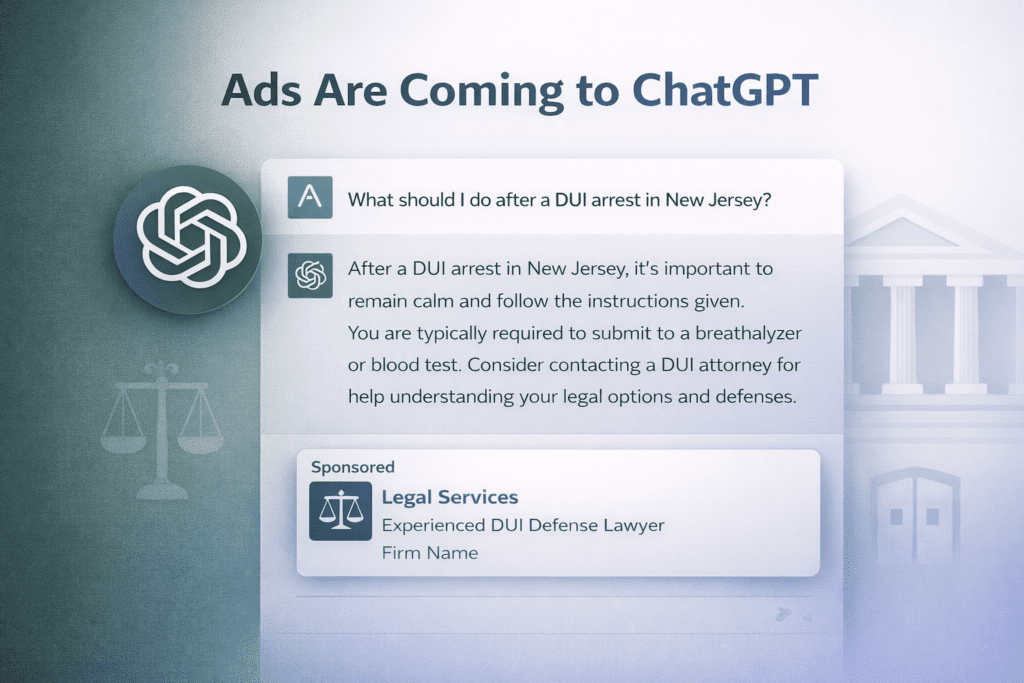

Law Firm ChatGPT: How to Get Your Firm to Show Up on AI Search Optimization Guide
For more than two decades, the internet search experience has looked roughly the same. Someone had a question, they opened Google, typed a query, and then browsed through several websites looking for answers. But that behavior is rapidly changing. Today, millions of people are skipping traditional search engines and going directly to AI tools like ChatGPT, Gemini, Claude, and Perplexity to ask questions about legal problems. Many of these platforms offer free access or free plans, allowing law firms to experiment with AI-powered search and visibility features at no cost. GPT, the generative AI technology behind ChatGPT and similar tools, enables these platforms to interact conversationally, perform web searches, and integrate into various applications. Instead of searching for: “Divorce lawyer near me” People are now asking AI tools: “What should I do if my spouse wants a divorce?” “How does divorce mediation work in New Jersey?” “Do I need a lawyer for a DUI?” “Who are the best personal injury lawyers near me?” Rather than showing ten links like Google does, AI tools provide a single structured answer, often summarizing information from several sources. These tools ‘read’ and process large volumes of online content, such as FAQs, citations, and search results, to generate their answers. These answers are often organized by topic, ensuring users receive relevant information quickly. Sometimes those answers even include law firm recommendations or references. AI-powered chatbots are a feature that can provide instant, around-the-clock support on a law firm’s website, improving client satisfaction. This shift creates a major opportunity for lawyers. The deal is, if your law firm appears in AI-generated responses, you can reach potential clients earlier in their research process—before they even start browsing search results. But if your firm is not visible in AI answers, you could miss out on a growing share of legal clients. ChatGPT can also rapidly create content such as blog posts and optimize web content for search engines, making it a valuable tool for law firm marketing. In this guide, we’ll explain: Why AI search is transforming legal marketing How many people use ChatGPT today How AI tools choose which law firms to mention The difference between SEO, AEO, and GEO Practical strategies to help your law firm appear in AI responses The Rise of AI Search Generative AI has become one of the fastest-adopted technologies in history. ChatGPT alone now has hundreds of millions of weekly users worldwide, and the platform processes billions of prompts every month. Consumers increasingly rely on AI tools to research: medical issues financial questions travel planning education legal matters With AI-powered tools, users can explore a wide range of legal topics, follow up with related questions, and delve deeper into specific areas of interest. Legal topics are particularly common because many people are looking for clear explanations of complex situations before deciding whether to contact a lawyer. For example, someone might ask: “What happens after a DUI arrest?” “How long does a divorce take?” “Should I hire a lawyer for a car accident claim?” AI tools can quickly provide structured answers explaining the process, the risks, and when legal help may be necessary. Law firms can apply AI to perform legal research, analyze client data, and improve their marketing strategies by identifying patterns in client inquiries and behavior. For law firms, this creates a new discovery channel. Instead of relying solely on Google search results, potential clients are now discovering legal services through AI-generated answers. Integrating generative AI into legal marketing can also help law firms analyze client data to better understand their needs and preferences. Additionally, AI-driven analytics can provide law firms with insights into the effectiveness of their marketing campaigns, allowing for data-driven adjustments. The Shift From “Search” to “Ask” Traditional search engines follow a simple model: Search → Browse → Compare A person types a query, opens several websites, compares information, and eventually decides who to contact. AI tools change that experience entirely. Instead of browsing multiple websites, users now ask a question and receive a synthesized answer. With AI, users can find the information they need more efficiently, as the technology quickly identifies and delivers relevant, high-quality insights. However, there is an important issue to consider: relying on AI-generated answers for legal advice can raise legal and ethical issues, such as the risk of inaccurate information, privacy concerns, and the potential for unauthorized practice of law. For example: Traditional search query: “Best personal injury lawyer in Chicago” AI prompt: “Who are some good personal injury lawyers in Chicago and what should I look for when hiring one?” Instead of showing ten blue links, AI tools may generate a single response that includes: an explanation of personal injury law advice on choosing a lawyer examples of law firms citations from authoritative websites This fundamentally changes online visibility. In traditional search results, dozens of firms might appear across several pages. In an AI answer, however, only a handful of sources may be referenced. That means if your law firm is not included in the AI’s knowledge sources, you may never be seen by that user. Using generative AI for content marketing also allows law firms to produce high-quality articles and resources that attract potential clients. How ChatGPT Finds Information About Law Firms To understand how to appear in AI responses, it’s important to understand how systems like ChatGPT gather information. It’s also important to note that the company behind ChatGPT, OpenAI, is ultimately responsible for how the AI is used and for ensuring compliance with legal and ethical standards. ChatGPT generates answers using two primary sources. 1. Training Data Large language models are trained on massive collections of text that include: websites articles books public data forums educational content This training helps the AI understand language and general knowledge. However, training data alone is not enough for answering many real-world questions. 2. Retrieval-Augmented Generation (RAG) Modern AI systems also use a process called Retrieval-Augmented Generation, often abbreviated as RAG. RAG allows AI tools to retrieve information from the web