

Key Takeaways
- More inquiries do not automatically produce more clients; the loss may occur at several stages after first contact.
- This article shows how to trace the path from lead quality through consultation and engagement.
- It helps law firms identify which part of the client-acquisition system deserves attention first.
Why Are Our Law Firm's Leads Not Turning Into Clients?
Leads can fail to become clients because the inquiries are unsuitable, contact attempts fail, consultations are not booked or attended, or suitable prospects do not sign after meeting the firm. First identify which stage is losing opportunities. More advertising helps when qualified demand is missing; it does not, by itself, resolve a breakdown after the inquiry.
Use the table below to investigate a recent group of inquiries from the same period. Keep open opportunities separate from confirmed losses, and compare practice areas separately where their qualification criteria or decision times differ.
A Practical Lead-to-Client Troubleshooting Checklist
| What you see | What to check | First action |
|---|---|---|
| Many inquiries concern work the firm does not accept. | Requested service, location, campaign, search terms and landing-page promises. | Clarify the offer and qualification criteria; adjust targeting and exclusions using actual inquiry reasons. |
| Calls, forms or chats appear in marketing reports but not in intake. | Missed calls, delivery failures, duplicate records and routing or integration errors. | Test each contact route and confirm that an inquiry reaches an assigned person with its source intact. |
| Suitable prospects are recorded but rarely reached. | Time to first human response, contact details, preferred contact method and documented attempts. | Assign follow-up ownership and a response process the team can reliably maintain. |
| Qualified prospects are reached but few book. | Appointment availability, clarity about consultation fees and the explanation of the next step. | Make scheduling and expectations clearer; ask the firm to review recurring objections. |
| Consultations are booked but often missed. | Booking-to-attendance rate, reminders, meeting instructions and cancellation reasons. | Confirm the appointment details and provide an easy way to reschedule. |
| Consultations happen but suitable prospects do not sign. | Fit, fees, timing, next steps, engagement follow-up and the prospect’s stated reason. | Have the responsible lawyer review the consultation and engagement process. Do not assume advertising is the cause. |
| The team cannot explain what happened. | Missing statuses, unknown sources and inconsistent definitions of a qualified or lost opportunity. | Agree on a small set of statuses and record the outcome before deciding which channel to cut. |
Use this as a diagnostic checklist, not a list of assumed faults. A prospect who does not respond is not automatically an unsuitable lead, and an open opportunity is not yet a lost client.
Illustrative Example: The Same Leads, Different Signing Results
Hypothetical example only; these figures are not benchmarks or reported client results. A campaign produces 40 inquiries. Twenty fit the firm’s criteria, 10 attend a consultation and four sign. That is a 50% qualification rate, a 50% qualified-to-attended rate and a 40% attended-to-signed rate.
The firm then improves scheduling and follow-up. If the same 20 qualified inquiries produced 15 attended consultations, and the signing rate stayed at 40%, six clients would sign. The calculation illustrates where an improvement could matter; it does not predict that a particular change will produce those results.
Compare this with a campaign where only four of 40 inquiries fit the firm’s services. That pattern points first toward reviewing targeting, messaging and qualification criteria. The location of the loss changes the next action.
Review a Recent Group of Inquiries Before Increasing Spend
- Select a consistent period. Choose inquiries old enough to have had a realistic chance to progress. Keep newer and still-open opportunities visible.
- Reconcile the records. Compare call, form and chat records with intake entries; remove duplicate inquiries from the same opportunity.
- Trace each outcome. Record source, matter fit, response attempts, consultations booked and attended, signing status and any stated loss reason.
- Find the recurring gap. Separate unsuitable demand from suitable opportunities lost after contact. Do not treat a handful of records as a reliable conversion benchmark.
- Assign one fix and a review date. Name the person responsible, the measure expected to improve and the period you will compare after the change.
A marketing partner can help diagnose campaign quality, contact capture, source tracking and connections to intake. The firm remains responsible for legal screening, consultations, engagement decisions and day-to-day intake ownership. The five client-acquisition essentials provide a useful foundation for that review.
Marketing Is Only One Piece of the Puzzle

Marketing plays an important role in generating awareness and driving opportunities.
Google Ads can generate clicks.
SEO can increase visibility.
Social media can build trust.
Referrals can create introductions.
But none of these activities guarantee growth.
Growth occurs when a firm has systems in place to consistently attract potential clients, capture opportunities, track performance, and convert inquiries into signed clients.
Think about the journey of a prospective client.
They discover your firm online.
They visit your website.
They decide whether to call, complete a form, start a chat conversation, or leave and contact a competitor.
If they do contact your firm, what happens next?
How quickly does someone respond?
Can leadership identify where that lead came from?
Can they determine whether that lead eventually became a client?
Every step matters.
When one part of the process breaks down, opportunities are lost.
The Four Pillars of Client Acquisition
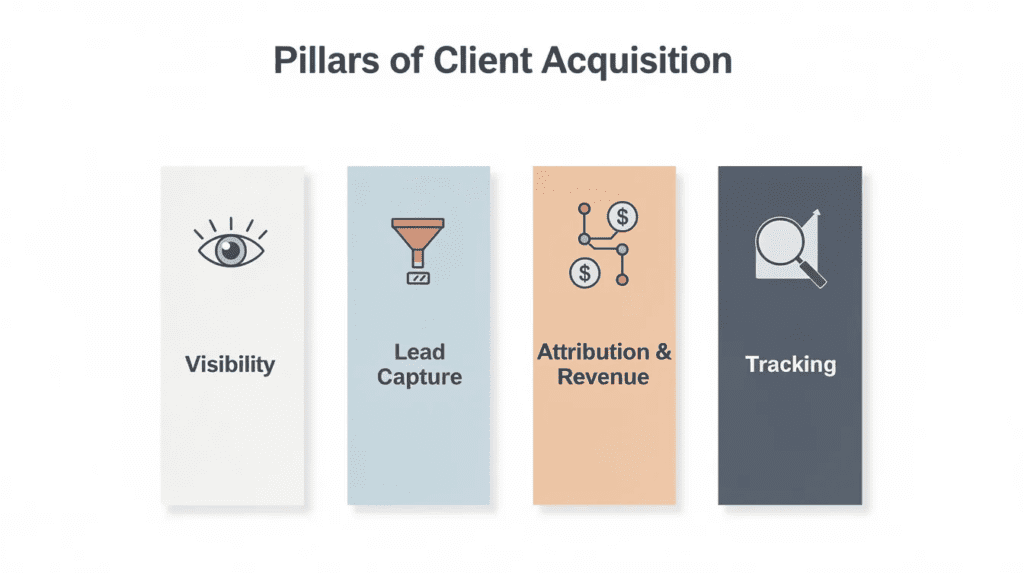
When evaluating a firm’s ability to generate consistent growth, four areas deserve attention.
Visibility
Before someone can hire your firm, they need to find it.
Today, visibility extends far beyond traditional search engines.
Prospective clients may discover your firm through Google Search, Google Business Profile, Local Services Ads, social media, referrals, YouTube, podcasts, or increasingly through AI-powered search tools such as ChatGPT.
Visibility is about ensuring your firm appears where prospective clients are actively searching for legal help.
Without visibility, there are no opportunities to capture.
Lead Capture
Generating interest is only the beginning.
Once someone decides to contact your firm, the experience should be simple and frictionless.
People facing legal issues are often dealing with stressful situations and looking for immediate answers.
If a phone call goes unanswered, a form submission sits untouched, or a visitor can’t find an easy way to contact the firm, that opportunity may disappear.
Successful firms make it easy for prospects to connect through multiple channels, including phone, forms, chat, text messaging, and answering services.
The easier it is to reach your firm, the more opportunities can be converted into consultations.
Client Attribution & Revenue Tracking
This is where growth-minded firms begin to separate themselves.
Lead volume is only one piece of the picture.
A firm may generate hundreds of leads each month, but if leadership cannot identify which marketing channels produced qualified consultations, signed clients, and revenue, it’s difficult to know where to invest next.
Consider this question:
If you had $5,000 more in marketing budget tomorrow, would you know exactly where to invest it?
The answer should be based on data, not intuition.
The strongest marketing decisions are made when leadership understands:
Which channels generate qualified leads
Which channels generate signed clients
Which channels generate revenue
Which channels deserve additional investment
This level of visibility allows firms to scale what is working while eliminating waste.
Tracking & Consent
Reliable reporting depends on reliable data.
Tracking systems provide the foundation for understanding marketing performance and client acquisition.
Analytics platforms, call tracking software, CRM systems, and conversion tracking tools help connect marketing activity to business outcomes.
At the same time, privacy regulations continue to evolve.
Proper consent management ensures website visitors can choose how their data is used while allowing firms to maintain accurate reporting and advertising performance.
Without reliable tracking, it becomes difficult to measure success, identify opportunities, or make informed decisions.
Law Firm Client Acquisition Answers
These concise answers connect the questions law firm leaders ask about lead quality, intake, attribution and marketing performance. Each answer links to a deeper KJ Strategy Group resource where more detail is useful.
What is law firm client acquisition?
Law firm client acquisition is the connected process of becoming visible to the right prospects, capturing their inquiries, moving qualified opportunities toward consultations and signed matters, and measuring which sources contributed to those outcomes. Marketing creates opportunities; intake systems capture and route them; the firm handles legal screening, consultations and signing; attribution connects the results back to marketing decisions.
What makes a law firm lead qualified?
A qualified lead generally has a legal need that matches the firm’s practice area, jurisdiction and case criteria and can take the appropriate next step. A qualified lead is not automatically a signed client. Firms should record qualification status and reasons for disqualification by source so they can distinguish a targeting problem from an intake or consultation problem.
Why don’t more leads always produce more clients?
Lead volume can rise while signed matters remain flat when the inquiry mix is wrong, calls are missed, responses are delayed, handoffs fail or follow-up is inconsistent. The useful comparison is not only cost per lead; it is the progression from inquiry to qualified opportunity, consultation and signed client. See why more leads do not always mean more clients and the five systems that support client acquisition.
What should happen after a prospective client contacts a law firm?
Each inquiry should be captured with its time, source and stated need; routed to the right person; acknowledged promptly; assigned a next action; and followed through to a clear outcome. The firm remains responsible for day-to-day intake, legal screening, consultations and signing. KJSG can connect the marketing-facing technology and tracking that support that process. Explore law firm intake technology and CRM integration.
How should law firms measure marketing performance?
At minimum, firms should compare spend, inquiries, qualified leads, consultations, signed clients and revenue by source where the necessary data is available. Cost per lead can help diagnose campaign efficiency, but cost per qualified opportunity and cost per signed client are closer to the business outcome. Reliable reporting depends on consistent lead-status updates and connected call, form, chat and CRM data. Read the guide to tracking law firm marketing ROI from click to client.
What should a law firm CRM track?
A useful CRM record includes the prospect’s contact details, original source and campaign, practice area, location or jurisdiction, qualification status, consultation status, signed or lost outcome, and—when appropriate—matter value or revenue. The system does not need unnecessary complexity, but its stages and fields must be used consistently. Learn how a law firm CRM connects marketing activity to outcomes.
Should a law firm add more marketing channels?
Only after an audit clarifies the firm’s growth goal, ideal matters, market, economics, current gaps and intake capacity. Each channel should have a defined role—capturing high-intent demand, building awareness, reaching a specific audience or supporting follow-up—and should fit the available budget and measurement system. KJSG’s law firm marketing services begin with strategy rather than running disconnected channels.
What should a law firm client-acquisition audit examine?
An audit should examine business goals, market positioning, channel performance, landing pages, calls, forms and chat, response pathways, CRM connections, lead-status data, attribution and reporting. Its purpose is to identify the main constraint and create a prioritized roadmap—not simply recommend more advertising. Start with the law firm client-acquisition checklist or discuss a deeper assessment.
What to Measure Through to Signed Clients
For each source and practice area, track inquiries, qualified inquiries, consultations booked and attended, signed clients and collected fees. Calculate qualification rate from inquiries, attendance from bookings and signing rate from attended consultations; keep the denominators consistent between reviews.
Also review response time, missing records and stated loss reasons. Keep open opportunities separate and allow enough time for a group of inquiries to progress. Compare total acquisition cost per signed client, including media, management and relevant tools, without counting duplicate inquiries as separate opportunities.
If lead quality improves but attendance stays weak, focus on scheduling and follow-up. If attendance improves but signing does not, ask the firm to examine fit and the engagement process. If too few suitable inquiries arrive, review demand generation. Use the marketing ROI guide to connect the records.
Your Next Step