

legal marketing strategy

Google Adwords, Law Firm Marketing

Digital Marketing for Legal Firms: What Works in 2026

Digital marketing for law firms has changed dramatically over the last few years—and 2026 is no exception. Between AI-driven search experiences, stricter privacy regulations, higher ad competition, and more informed consumers, law firms can no longer rely on outdated tactics or “set it and forget it” strategies. In 2026, successful legal marketing is not about doing everything—it’s about doing the right things, exceptionally well, with a focus on trust, visibility, and measurable results. Digital strategies such as SEO/GEO, PPC, and content marketing form the foundation for law firms to attract clients and grow a law firm’s business. This guide breaks down what actually works in digital marketing for lawfirms in 2026, what’s losing effectiveness, and how law firms can stay competitive in an increasingly crowded online landscape. Digital marketing for law firms is essential for generating client leads and growing a law firm’s business. The State of Law Firm Digital Marketing in 2026 Before diving into tactics, it’s important to understand what has changed. Search is no longer limited to Google. Potential clients now ask questions on Google, YouTube, TikTok, Reddit, and AI tools like ChatGPT and Gemini before ever contacting a lawyer. Clients are also far more educated. By the time someone fills out a form, they often already understand their legal issue at a high level. Advertising costs continue to rise, especially in competitive practice areas such as family law, criminal defense, personal injury, and immigration. Understanding your client base is crucial for targeting marketing efforts and attracting new clients, ensuring your strategies are focused on the audiences most likely to engage your firm. At the same time, trust matters more than ever. Reviews, video presence, transparency, and authority heavily influence which firm gets the call. Legal marketing in 2026 is less about volume and more about quality visibility and conversion efficiency. Unlike traditional marketing methods, which cast a wide net, today’s digital strategies allow for more precise targeting and measurable results, helping firms reach the right prospects more effectively. Search Still Matters—But It’s Smarter and Broader Search Engine Optimization is still foundational, but it has evolved significantly. SEO is essential for law firms to improve their visibility in search engine results pages (SERPs), and approximately 96% of consumers use search engines when seeking legal services. What works today includes practice-area-focused content, pages that answer specific legal questions, strong internal linking, fast mobile-first websites, and proper schema markup—especially FAQ and review schema. What matters more now is entity-based SEO. Search engines and AI tools evaluate your firm, your lawyers, and your topical authority as connected entities rather than isolated pages. Law firm SEO is particularly challenging because Google holds legal content to higher standards of expertise, authority, and trustworthiness (E-A-T). Local relevance has also overtaken national vanity keywords. For most firms, winning locally produces better leads at a lower cost. A strong local SEO strategy is vital for law firms to attract clients in their geographic area, especially since most potential clients search for attorneys nearby. When marketing legal services, SEO is no longer about tricking algorithms—it’s about being the most helpful and trustworthy legal resource in your market. High-quality, relevant content is a critical factor for improving SEO rankings for law firms, and SEO strategies should include obtaining backlinks from credible sources to improve authority and ranking. Ranking on the first page of Google is crucial for law firms, as only 2-3% of users click on results from the second page. Your law firm website is the foundation of your digital marketing strategy and often the first impression potential clients will have of your brand. A strong digital marketing strategy also boosts visibility across key channels like Google search, legal directories, and review platforms, helping you reach more clients searching for legal services. AI Visibility Is the New Search Engine Optimization Frontier One of the biggest shifts in legal marketing in 2026 is visibility inside AI-generated answers. Online strategies such as SEO, content marketing, webinars, email campaigns, and especially video marketing are now essential for law firms. These strategies not only increase visibility and attract clients but also help build trust and shape the impression potential clients have before initial consultations. A well-designed, user-friendly website, combined with authoritative resources and engaging video content, enhances the first impression potential clients form and differentiates your firm in a competitive market. Potential clients are asking conversational questions such as: Do I need a lawyer for a first-time DUI? How does divorce mediation work when children are involved? What happens after an arrest? Law firms that appear in AI summaries, featured snippets, knowledge panels, and conversational search results gain trust before competitors are even seen. Improving AI visibility requires publishing relevant, plain-language legal explanations, structuring content with FAQs, incorporating video marketing, and providing authoritative resources as part of a comprehensive online strategy. Avoid exaggerated claims, maintain consistent firm and lawyer information online, and build topical authority rather than publishing high volumes of shallow content. In 2026, if AI can’t understand your firm, it can’t recommend you. Paid Search Still Works—But Only When It’s Strategic Paid Search (Google Ads, Microsoft Ads & Local Service Ads) Google Ads and Microsoft Ads remain critical growth channels for law firms—but in 2026, they reward precision, data quality, and downstream accountability. Paid search is no longer about driving the highest volume of leads; it is about driving retained clients, signed cases, and measurable return on ad spend. Successful firms now build intent-driven campaigns with fewer, more controlled keyword groupings, practice-area-specific landing pages, and advanced conversion tracking that extends beyond form fills and phone calls. While ads still appear at the top of search results, visibility alone is no longer the goal—profitability is. Search behavior has also changed. Prospective clients increasingly use longer, more conversational queries and problem-based searches rather than short, generic keywords. This means law firms can no longer rely solely on short-tail terms like “lawyer” or “attorney.” Modern paid search strategies must account for: Long-tail and mid-funnel queries Broad match paired with smart

Law Firm Marketing

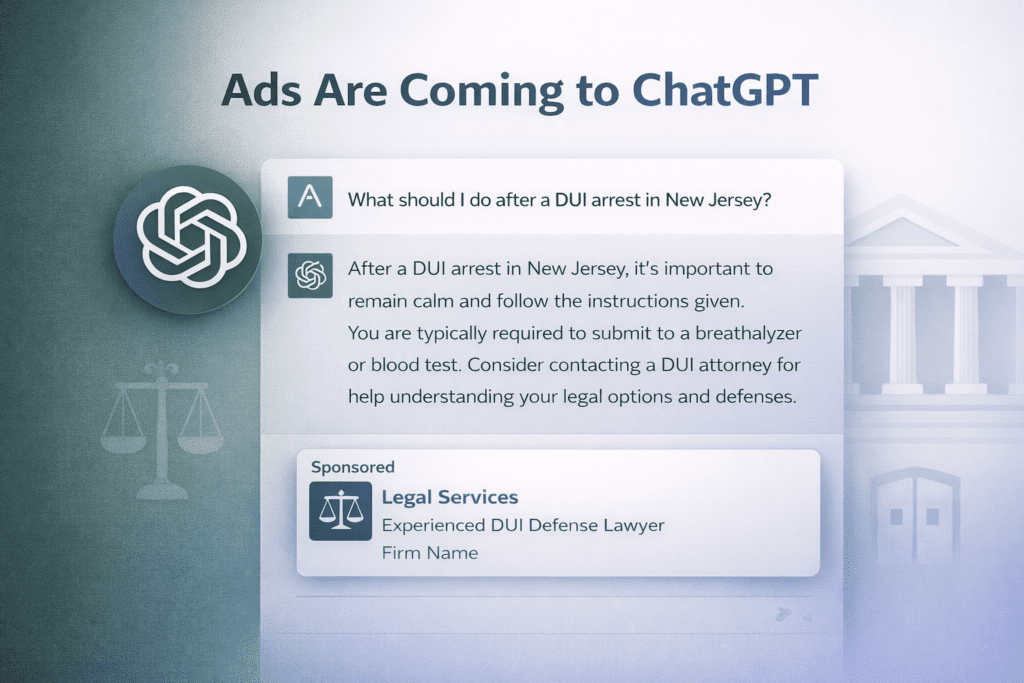
ChatGPT Ads Are Here: What Law Firms Need to Know About Advertising in AI Search

OpenAI’s launch of ads inside ChatGPT marks a significant shift—not just for artificial intelligence, but for how people discover information online, including legal services. As more consumers turn to AI platforms like ChatGPT and Perplexity for legal questions before visiting Google or a law firm’s website, this development has important implications for law firm marketing. OpenAI plans to introduce ads beginning in 2026 as part of its broader effort to monetize ChatGPT while maintaining free access for users. According to OpenAI, ads will be integrated carefully to preserve user trust and ensure that ChatGPT’s responses remain independent and objective. For law firms, this is not simply a new advertising channel. It reflects a broader shift toward AI-driven discovery, where people begin researching legal issues through conversational tools rather than traditional search engines. Who Will See ChatGPT Ads? During the initial rollout, ads will be shown to: Logged-in adult users in the United States Users on the Free and Go subscription tiers Higher-tier plans—including Plus, Pro, Business, Enterprise, and Education accounts—will remain ad-free. ChatGPT’s responses are generated independently and are not influenced by advertisers. OpenAI has stated that it does not sell user chat data to advertisers and that advertisers receive only aggregated reporting. What Are ChatGPT Ads? ChatGPT Ads are clearly labeled sponsored placements that appear below the AI’s response. Ads are not embedded within ChatGPT’s answers, and OpenAI has emphasized a strict separation between AI-generated content and paid advertising. Key characteristics: Ads appear after ChatGPT’s response Ads are contextual, based on the topic of the conversation Ads are limited to non-sensitive topics Paid plans remain ad-free Users may opt out of ad personalization based on chat data and can clear any data used for advertising purposes. Ads will not be shown to users under 18. An educational explanation of the legal process from ChatGPT Followed by a sponsored legal services ad displayed below the response May receive: How This Could Apply to Legal Searches For example, a user asking: “What should I do after a DUI arrest in New Jersey?” This differs from traditional search advertising because ads appear within a conversational research experience, rather than a keyword-based search results page. Why This Matters for Law Firms Legal marketing has consistently followed changes in how people seek information. Increasingly, consumers are using AI systems/assistants to ask questions such as: “Do I need a lawyer for this?” “How does divorce mediation work?” “What happens after a criminal charge?” “Can a xyz record be expunged?” These are early-stage, high-intent questions, and ChatGPT is becoming a common starting point for this type of research. ChatGPT Ads introduce a scenario where: Law firms may appear earlier in the research process Visibility may occur before a user conducts a Google search AI tools begin to influence how law firms are discovered How ChatGPT Ads Differ From Google Ads ChatGPT Ads are not a replacement for Google Ads, but they function differently. Google Ads Keyword-driven Appear on search results pages Often target users who are ready to take action ChatGPT Ads Conversation-based Contextual rather than keyword-triggered Appear during the research and learning phase For law firms, this suggests a potential shift toward earlier visibility, rather than immediate lead capture. Ethics, Trust, and Legal Advertising Considerations Legal advertising is highly regulated, and OpenAI’s ad framework reflects this sensitivity: Ads are excluded from certain sensitive categories Sponsored content is clearly labeled User data is not sold to advertisers Reporting is aggregated, not user-specific Law firms advertising through AI platforms will still need to comply with: Applicable bar advertising rules Restrictions on misleading claims or guarantees Jurisdictional and practice-area limitations This environment favours clear, factual, and professional messaging. Which Practice Areas May See Early Relevance Practice areas that involve frequent educational questions may see relevance earlier, including: Criminal defense Family law Immigration law Estate planning Early-stage personal injury inquiries These areas commonly involve users seeking guidance before deciding whether to contact a lawyer. How Law Firms Can Prepare Even if ChatGPT Ads are not immediately available to most law firms, preparation can begin now. Focus areas include: Creating clear, educational website content Publishing well-structured FAQs and practice area pages Clearly defining practice areas, jurisdictions, and services Emphasizing accuracy and clarity over marketing language These steps support both organic AI visibility and future advertising efforts. The Bigger Picture ChatGPT Ads reflect a broader trend: AI tools are becoming a starting point for legal research. While traditional search engines remain important, AI assistants are increasingly part of how people learn about legal issues. For law firms, this means adapting to a landscape where visibility, credibility, and clarity matter earlier in the client journey. ChatGPT Ads represent an early step in the evolution of AI-driven discovery. While the ad model is still developing, the underlying shift in consumer behavior is already underway. For law firms, the key question is not whether AI will influence how clients find legal services—but how prepared firms are to be visible, accurate, and trustworthy in these emerging environments. At KJ Strategy Group, we continue to monitor how AI is affecting legal marketing, discovery, and lead generation to help firms make informed decisions as this landscape evolves.

Law Firm Marketing in Philadelphia
Law Firm Marketing

Law Firm Marketing: How Small Firms Can Compete With Big-Budget Competitors In Philadelphia

Philadelphia is one of the most competitive legal markets in the United States. Large firms dominate billboards along I-95, sponsor major local events, and flood radio stations with ads that run every hour. For small and midsize firms, it often feels impossible to compete with that level of exposure. This leads many attorneys to believe that success in law firm marketing requires matching those budgets, which simply is not realistic for most local practices. The truth is that online competition in Philadelphia works very differently. Law firm marketing is no longer dominated by who spends the most but by who communicates better, targets smarter, and responds faster. Clients searching online are not impressed by size alone. They choose firms that appear reliable, local, and easy to reach in the exact moment help is needed. That is where smaller firms can outperform much larger competitors. Law Firm Marketing: Why Precision Beats Size In Philadelphia Small firms in Philadelphia have a strategic advantage that large firms often lack: focus. While big firms market across multiple practice areas and jurisdictions at the same time, smaller firms can concentrate on a narrow audience and a defined geographic footprint. That precision changes everything. Search engines favour relevance over reputation. A law firm that builds content around specific neighbourhoods, courts, and case types in Philadelphia will consistently outperform a general-use website that tries to appeal to everyone. A focused landing page for divorce cases in Center City or personal injury claims in North Philadelphia attracts more qualified visitors than a generic homepage ever could. The tighter the message, the better the conversion. Smaller firms also benefit from speed. They can change campaigns quickly, update copy without delay, and refine messaging in real time. Large organizations tend to move slowly due to approvals and internal processes. In online advertising, delays cost opportunity. Firms that adapt faster tend to dominate search results over time. Hyperfocused Campaigns That Deliver Better Local Leads Many advertising campaigns fail not because they lack funding, but because they lack direction. Broad marketing invites irrelevant traffic. Focused campaigns attract clients who are ready to take action. Philadelphia legal clients search with urgency and with intent. They do not search for firms. They search for solutions using practical phrases tied to real problems and real locations. When a firm builds its advertising around those exact behaviours, results improve immediately. Hyperfocused marketing also allows firms to allocate budget where it performs best. Instead of advertising everywhere, successful firms focus on the parts of Philadelphia that generate the most qualified calls. They track which neighbourhoods convert best, which pages produce consultations, and which keywords signal high intent. Over time, data replaces guessing. Automation As The Equalizer For Philadelphia Law Firms Response speed is one of the biggest decision factors in legal marketing. In a city as competitive as Philadelphia, potential clients often contact several firms within minutes. The attorney who replies first usually controls that conversation. Automation closes the gap between inquiry and response. Online scheduling, automated replies, CRM systems, and live chat tools allow small firms to behave like much larger organizations. Every inquiry receives immediate acknowledgment. Every lead is captured. No opportunity is lost due to slow response. Automation does not remove personal interaction. It supports it. It creates consistency, reduces human error, and ensures that follow-ups happen automatically. A smaller team with a well-built system will always outperform a larger team with no structure. Building Trust Without A Big Name In Philadelphia Philadelphia clients are skeptical by nature. They do not hire attorneys easily. Trust must be earned quickly and authentically. So websites that rely on aggressive language or generic legal claims tend to fail. Clients are not looking to be sold. They are looking to feel safe. When a website explains what happens next, how consultations work, and what type of support clients will receive, it builds confidence immediately. Trust also requires visibility. Real photos of your team, clear explanations of services, and direct contact options send a strong message: this is a real firm with real people, not just a brand. The most effective trust-building elements include: Clear photos of attorneys and staff, not stock images; Easy access to contact information from every page; Simple explanations of legal services without complex terminology; Honest descriptions of the process involved in hiring an attorney; Testimonials, clients or similar case types; Trust grows through transparency. Small firms that humanize their online presence build loyalty faster than large firms that rely purely on volume. Law Firm Marketing In Philadelphia Competing online in Philadelphia does not require massive ad spend. It requires a system designed to convert attention into clients. KJ Strategy Group helps law firms replace ineffective advertising with performance-driven marketing strategies tailored for competitive local markets like Philadelphia. If your firm is ready to stop chasing visibility and start generating real consultations, contact us and build a strategy designed to compete, convert, and grow.

Law Firm Marketing

Law Firm Web Marketing: What Most Small Firms Get Wrong About Online Advertising

Small and midsize law firms face a unique challenge in the digital space. They want visibility, leads, and measurable growth, but often waste valuable resources on campaigns that never convert. The issue is rarely the budget itself, it’s the way that budget is used. Many firms treat online advertising like traditional marketing, expecting instant results without building a strategy around how real clients search and decide. Law firm web marketing is not just about traffic. It is about trust, timing, and guiding potential clients from a search query to a signed consultation. Understanding what not to do is just as important as knowing what to do. Why Small Firms Struggle with Online Ads Most small firms start online marketing by following what they see competitors doing: Google Ads, social media boosts, or directory listings. While these channels can work, they often fail when used without structure. Sending paid traffic to a homepage that does not speak directly to a client’s needs is one of the biggest mistakes. A homepage is usually too broad, it tries to explain everything to everyone. A person searching for a “car accident lawyer near me” or a “divorce attorney available today” wants a clear answer, not a list of every practice area your firm handles. Targeted landing pages, focused on one service and one audience, consistently perform better. Another common issue is neglecting mobile optimization. Many clients search from their phones, especially in urgent legal situations. If your site loads slowly or the contact form is hard to use, the client will leave within seconds. Key Mistakes in Law Firm Web Marketing Understanding where most campaigns go wrong helps avoid costly errors. Below are the most common pitfalls in law firm web marketing and what to do instead. Sending ads to generic homepages. Create specific landing pages for each practice area. Tailor the message and call to action to what the user searched for. Ignoring tracking and analytics. Without tools like Google Analytics or call tracking, you cannot know what works. Measure results and adjust based on real data. Writing ad copy for clicks, not clients. Avoid sensational or vague headlines. Speak directly to the client’s problem and show what happens next. Neglecting reviews and testimonials. Potential clients often look for social proof before calling. Showcase client feedback and ratings to build credibility. Failing to evaluate lead quality. Not every inquiry is a good fit. Track which types of leads actually become clients to refine your targeting and improve your return on ad spend. Having no lead handling process. Many law firms lose cases not because of poor marketing, but because they don’t follow up fast enough. Establish a clear intake process—respond quickly, personalize communication, and ensure no potential client slips through the cracks. By fixing these areas, even small firms with modest budgets can compete with larger players and see measurable returns on their investment. At KJ Strategy Group, we even have an ebook dedicated on how law firms can be efficient in lead generation, you can read it here. Partner with KJ Strategy Group to Improve Web Marketing Results Clicks mean nothing if they do not turn into conversations. Once someone arrives at your website, the goal is to make it easy for them to act. Clear contact forms, visible phone numbers, and fast live chat tools help capture leads in real time. Equally important is your follow-up system. Every minute of delay can cost a client. An email or text confirmation after form submission shows that their message was received and will be handled quickly. Automated intake tools and CRMs make this process faster and more consistent. KJ Strategy Group helps small and midsize law firms fix the weak points in their online advertising. Their team builds campaigns that connect traffic, landing pages, and intake tools into one seamless system that converts visitors into paying clients. If your law firm is tired of spending on ads that do not deliver, it is time to rethink your digital approach. Contact KJ Strategy Group today to create a web marketing strategy that attracts the right audience and turns more clicks into consultations.

Scroll to Top