AI Search

Law Firm ChatGPT: How to Get Your Firm to Show Up on AI Search Optimization Guide
AI Search, Law Firm Marketing, Search Marketing, SEO

Law Firm ChatGPT: How to Get Your Firm to Show Up on AI Search Optimization Guide

For more than two decades, the internet search experience has looked roughly the same. Someone had a question, they opened Google, typed a query, and then browsed through several websites looking for answers. But that behavior is rapidly changing. Today, millions of people are skipping traditional search engines and going directly to AI tools like ChatGPT, Gemini, Claude, and Perplexity to ask questions about legal problems. Many of these platforms offer free access or free plans, allowing law firms to experiment with AI-powered search and visibility features at no cost. GPT, the generative AI technology behind ChatGPT and similar tools, enables these platforms to interact conversationally, perform web searches, and integrate into various applications. Instead of searching for: “Divorce lawyer near me” People are now asking AI tools: “What should I do if my spouse wants a divorce?” “How does divorce mediation work in New Jersey?” “Do I need a lawyer for a DUI?” “Who are the best personal injury lawyers near me?” Rather than showing ten links like Google does, AI tools provide a single structured answer, often summarizing information from several sources. These tools ‘read’ and process large volumes of online content, such as FAQs, citations, and search results, to generate their answers. These answers are often organized by topic, ensuring users receive relevant information quickly. Sometimes those answers even include law firm recommendations or references. AI-powered chatbots are a feature that can provide instant, around-the-clock support on a law firm’s website, improving client satisfaction. This shift creates a major opportunity for lawyers. The deal is, if your law firm appears in AI-generated responses, you can reach potential clients earlier in their research process—before they even start browsing search results. But if your firm is not visible in AI answers, you could miss out on a growing share of legal clients. ChatGPT can also rapidly create content such as blog posts and optimize web content for search engines, making it a valuable tool for law firm marketing. In this guide, we’ll explain: Why AI search is transforming legal marketing How many people use ChatGPT today How AI tools choose which law firms to mention The difference between SEO, AEO, and GEO Practical strategies to help your law firm appear in AI responses The Rise of AI Search Generative AI has become one of the fastest-adopted technologies in history. ChatGPT alone now has hundreds of millions of weekly users worldwide, and the platform processes billions of prompts every month. Consumers increasingly rely on AI tools to research: medical issues financial questions travel planning education legal matters With AI-powered tools, users can explore a wide range of legal topics, follow up with related questions, and delve deeper into specific areas of interest. Legal topics are particularly common because many people are looking for clear explanations of complex situations before deciding whether to contact a lawyer. For example, someone might ask: “What happens after a DUI arrest?” “How long does a divorce take?” “Should I hire a lawyer for a car accident claim?” AI tools can quickly provide structured answers explaining the process, the risks, and when legal help may be necessary. Law firms can apply AI to perform legal research, analyze client data, and improve their marketing strategies by identifying patterns in client inquiries and behavior. For law firms, this creates a new discovery channel. Instead of relying solely on Google search results, potential clients are now discovering legal services through AI-generated answers. Integrating generative AI into legal marketing can also help law firms analyze client data to better understand their needs and preferences. Additionally, AI-driven analytics can provide law firms with insights into the effectiveness of their marketing campaigns, allowing for data-driven adjustments. The Shift From “Search” to “Ask” Traditional search engines follow a simple model: Search → Browse → Compare A person types a query, opens several websites, compares information, and eventually decides who to contact. AI tools change that experience entirely. Instead of browsing multiple websites, users now ask a question and receive a synthesized answer. With AI, users can find the information they need more efficiently, as the technology quickly identifies and delivers relevant, high-quality insights. However, there is an important issue to consider: relying on AI-generated answers for legal advice can raise legal and ethical issues, such as the risk of inaccurate information, privacy concerns, and the potential for unauthorized practice of law. For example: Traditional search query: “Best personal injury lawyer in Chicago” AI prompt: “Who are some good personal injury lawyers in Chicago and what should I look for when hiring one?” Instead of showing ten blue links, AI tools may generate a single response that includes: an explanation of personal injury law advice on choosing a lawyer examples of law firms citations from authoritative websites This fundamentally changes online visibility. In traditional search results, dozens of firms might appear across several pages. In an AI answer, however, only a handful of sources may be referenced. That means if your law firm is not included in the AI’s knowledge sources, you may never be seen by that user. Using generative AI for content marketing also allows law firms to produce high-quality articles and resources that attract potential clients. How ChatGPT Finds Information About Law Firms To understand how to appear in AI responses, it’s important to understand how systems like ChatGPT gather information. It’s also important to note that the company behind ChatGPT, OpenAI, is ultimately responsible for how the AI is used and for ensuring compliance with legal and ethical standards. ChatGPT generates answers using two primary sources. 1. Training Data Large language models are trained on massive collections of text that include: websites articles books public data forums educational content This training helps the AI understand language and general knowledge. However, training data alone is not enough for answering many real-world questions. 2. Retrieval-Augmented Generation (RAG) Modern AI systems also use a process called Retrieval-Augmented Generation, often abbreviated as RAG. RAG allows AI tools to retrieve information from the web

AI Search, Google Adwords, Law Firm Marketing, Paid Search, Search Marketing, SEO

Search Engine Marketing for Lawyers: SEO + GEO + PPC (OmniSearch) – The Ultimate Digital Marketing Combo for Family Law Attorneys

Introduction: Search Has Changed—and Family Law Firms Feel It First Search engine marketing is no longer just about ranking #1 on Google for “divorce lawyer near me.” The way people search for legal help—especially emotionally charged, high-stakes help like family law—has fundamentally changed. Today’s prospective clients: Ask AI tools like ChatGPT and Google AI Overviews deeply personal legal questions Read Reddit threads to see how “real people” handled divorce or custody battles Watch YouTube videos explaining what to expect in family court Compare lawyers on online directories like Avvo and Justia Click paid search ads when urgency peaks Search no longer happens in one place. It happens everywhere. For family law attorneys, this creates both a challenge and an opportunity. Firms that rely on only one channel—SEO or Google Ads—are slowly losing visibility as attention fragments across platforms and AI-powered search experiences. Comprehensive law firm marketing and legal marketing strategies now integrate branding, SEO, local search, and digital advertising to enhance online visibility and reputation. Online visibility is crucial for attracting clients, as search engine results are the primary way users find and select law firms. The legal profession is highly competitive in digital marketing, making a robust SEO strategy essential for improving search engine rankings and standing out in search engine results. The firms that will dominate the next decade are adopting a Unified Search Strategy, also known as OmniSearch. OmniSearch combines: SEO (Search Engine Optimization) GEO (Generative Engine Optimization for AI search) PPC (Pay-Per-Click advertising) Together, these channels create immediate visibility and long-term authority—exactly what family law marketing demands. What Is OmniSearch? OmniSearch is a holistic approach to digital visibility. Instead of treating SEO, PPC, and AI search as separate tactics, OmniSearch aligns them into a single strategy focused on how people actually search today. The goal is simple: A unified marketing campaign ensures your law firm is present for the most relevant search queries across search engine results pages, maximizing search traffic from prospective clients. Be present at every meaningful search touchpoint—before, during, and after a client decides to hire a lawyer. OmniSearch acknowledges that: Some clients are ready to hire now Others are researching quietly for months Many turn to AI, forums, and videos before ever calling a firm Family law decisions are rarely impulsive—but when urgency hits, visibility matters instantly. That’s why SEO, GEO, and PPC must work together. Pillar 1: SEO – The Long-Term Authority Engine SEO remains the backbone of any serious digital marketing strategy for family law attorneys. But its role has evolved. Today, law firm SEO, lawyer SEO, and SEO for law firms are specialized strategies tailored for legal practices. A comprehensive law firm SEO strategy is essential for long-term growth, helping law firms build authority, attract qualified leads, and convert them into clients. SEO is no longer just about traffic—it’s about credibility, education, and discoverability across platforms, including AI tools. SEO work now encompasses technical SEO, on page optimization, and effective link building as foundational elements for improving search engine rankings and visibility in search engine results. These efforts ensure your law firm’s website is optimized for both users and search engines. Core SEO assets include thorough keyword research to identify relevant keywords, keyword phrases, long tail keywords, and a targeted keyword strategy. These are essential for optimizing content and attracting organic search traffic from potential clients searching for legal services in your practice areas and locations. Organic search and high rankings in organic search results on search engine results pages (SERPs) are critical for law firms. Achieving top positions in SERPs not only drives website traffic and brings in more website visitors, but also enhances your law firm’s reputation, as high rankings are perceived as endorsements of authority. Content marketing is a key component of law firm SEO. Regularly publishing informative blog posts, maintaining a comprehensive faq page, and creating other content formats that answer common legal questions help establish your firm’s authority and attract organic traffic. This approach builds trust with potential clients and supports your overall SEO success. Technical SEO is a measure of how ‘Google-friendly’ your law firm’s website is. It includes optimizing meta descriptions, monitoring core web vitals for page speed and responsiveness, implementing structured data, and maintaining an up-to-date XML sitemap. Ensuring your website is mobile-friendly and fast-loading is essential, as search engines penalize slow or poorly structured sites. A well-structured website with easy navigation enhances user experience and can lead to higher conversion rates. Using third party tool and analytics tools to track website performance, website traffic, and SEO success is crucial. Monitoring these metrics allows law firms to understand the effectiveness of their SEO efforts and make data-driven adjustments. Link building, including acquiring referring links and citations from other websites, is vital for improving your site’s authority and search engine rankings. Effective link building strategies such as directory listings, guest posting, and outreach to reputable sources can significantly boost your SEO results. While Google is the dominant search engine, optimizing for other search engines like Bing and others can further expand your online visibility. The structure of your law firm’s website and individual web pages should prioritize easy navigation and user experience. Technical SEO ensures your site is mobile-friendly, fast, and easy to navigate, which are critical for both user satisfaction and search rankings. Developing SEO skills internally or hiring an experienced SEO consultant can help ensure your SEO efforts are effective and aligned with industry best practices. Finally, user behavior on the search results page—such as clicks, time spent, and engagement—can influence your rankings. Monitoring and analyzing SEO performance metrics is essential for ongoing SEO success and adapting to changes in search engine algorithms. What SEO Does Best for Family Law Firms Captures Research-Based SearchesMany potential clients aren’t ready to call a lawyer yet. They search questions like: “How does child custody work?” “Is mediation better than divorce court?” “What happens if my spouse won’t cooperate?” SEO allows your firm to show up early—before competitors even know the client exists.

AI Search, Law Firm Marketing, Search Marketing, SEO

ChatGPT Ads Are Here: What Law Firms Need to Know About Advertising in AI Search

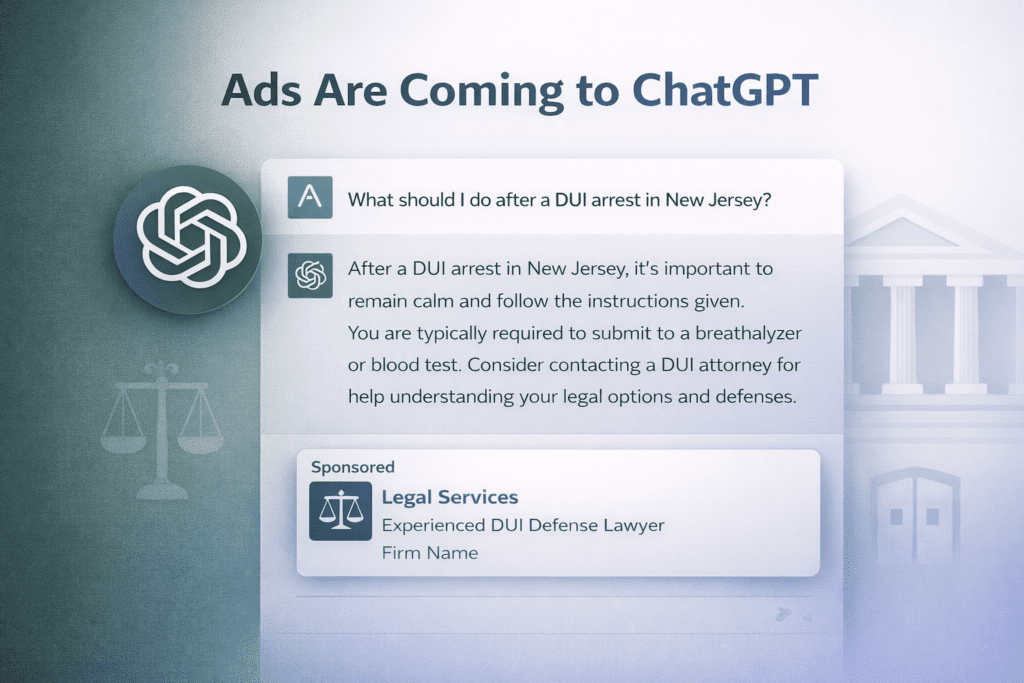
OpenAI’s launch of ads inside ChatGPT marks a significant shift—not just for artificial intelligence, but for how people discover information online, including legal services. As more consumers turn to AI platforms like ChatGPT and Perplexity for legal questions before visiting Google or a law firm’s website, this development has important implications for law firm marketing. OpenAI plans to introduce ads beginning in 2026 as part of its broader effort to monetize ChatGPT while maintaining free access for users. According to OpenAI, ads will be integrated carefully to preserve user trust and ensure that ChatGPT’s responses remain independent and objective. For law firms, this is not simply a new advertising channel. It reflects a broader shift toward AI-driven discovery, where people begin researching legal issues through conversational tools rather than traditional search engines. Who Will See ChatGPT Ads? During the initial rollout, ads will be shown to: Logged-in adult users in the United States Users on the Free and Go subscription tiers Higher-tier plans—including Plus, Pro, Business, Enterprise, and Education accounts—will remain ad-free. ChatGPT’s responses are generated independently and are not influenced by advertisers. OpenAI has stated that it does not sell user chat data to advertisers and that advertisers receive only aggregated reporting. What Are ChatGPT Ads? ChatGPT Ads are clearly labeled sponsored placements that appear below the AI’s response. Ads are not embedded within ChatGPT’s answers, and OpenAI has emphasized a strict separation between AI-generated content and paid advertising. Key characteristics: Ads appear after ChatGPT’s response Ads are contextual, based on the topic of the conversation Ads are limited to non-sensitive topics Paid plans remain ad-free Users may opt out of ad personalization based on chat data and can clear any data used for advertising purposes. Ads will not be shown to users under 18. An educational explanation of the legal process from ChatGPT Followed by a sponsored legal services ad displayed below the response May receive: How This Could Apply to Legal Searches For example, a user asking: “What should I do after a DUI arrest in New Jersey?” This differs from traditional search advertising because ads appear within a conversational research experience, rather than a keyword-based search results page. Why This Matters for Law Firms Legal marketing has consistently followed changes in how people seek information. Increasingly, consumers are using AI systems/assistants to ask questions such as: “Do I need a lawyer for this?” “How does divorce mediation work?” “What happens after a criminal charge?” “Can a xyz record be expunged?” These are early-stage, high-intent questions, and ChatGPT is becoming a common starting point for this type of research. ChatGPT Ads introduce a scenario where: Law firms may appear earlier in the research process Visibility may occur before a user conducts a Google search AI tools begin to influence how law firms are discovered How ChatGPT Ads Differ From Google Ads ChatGPT Ads are not a replacement for Google Ads, but they function differently. Google Ads Keyword-driven Appear on search results pages Often target users who are ready to take action ChatGPT Ads Conversation-based Contextual rather than keyword-triggered Appear during the research and learning phase For law firms, this suggests a potential shift toward earlier visibility, rather than immediate lead capture. Ethics, Trust, and Legal Advertising Considerations Legal advertising is highly regulated, and OpenAI’s ad framework reflects this sensitivity: Ads are excluded from certain sensitive categories Sponsored content is clearly labeled User data is not sold to advertisers Reporting is aggregated, not user-specific Law firms advertising through AI platforms will still need to comply with: Applicable bar advertising rules Restrictions on misleading claims or guarantees Jurisdictional and practice-area limitations This environment favours clear, factual, and professional messaging. Which Practice Areas May See Early Relevance Practice areas that involve frequent educational questions may see relevance earlier, including: Criminal defense Family law Immigration law Estate planning Early-stage personal injury inquiries These areas commonly involve users seeking guidance before deciding whether to contact a lawyer. How Law Firms Can Prepare Even if ChatGPT Ads are not immediately available to most law firms, preparation can begin now. Focus areas include: Creating clear, educational website content Publishing well-structured FAQs and practice area pages Clearly defining practice areas, jurisdictions, and services Emphasizing accuracy and clarity over marketing language These steps support both organic AI visibility and future advertising efforts. The Bigger Picture ChatGPT Ads reflect a broader trend: AI tools are becoming a starting point for legal research. While traditional search engines remain important, AI assistants are increasingly part of how people learn about legal issues. For law firms, this means adapting to a landscape where visibility, credibility, and clarity matter earlier in the client journey. ChatGPT Ads represent an early step in the evolution of AI-driven discovery. While the ad model is still developing, the underlying shift in consumer behavior is already underway. For law firms, the key question is not whether AI will influence how clients find legal services—but how prepared firms are to be visible, accurate, and trustworthy in these emerging environments. At KJ Strategy Group, we continue to monitor how AI is affecting legal marketing, discovery, and lead generation to help firms make informed decisions as this landscape evolves.

Scroll to Top